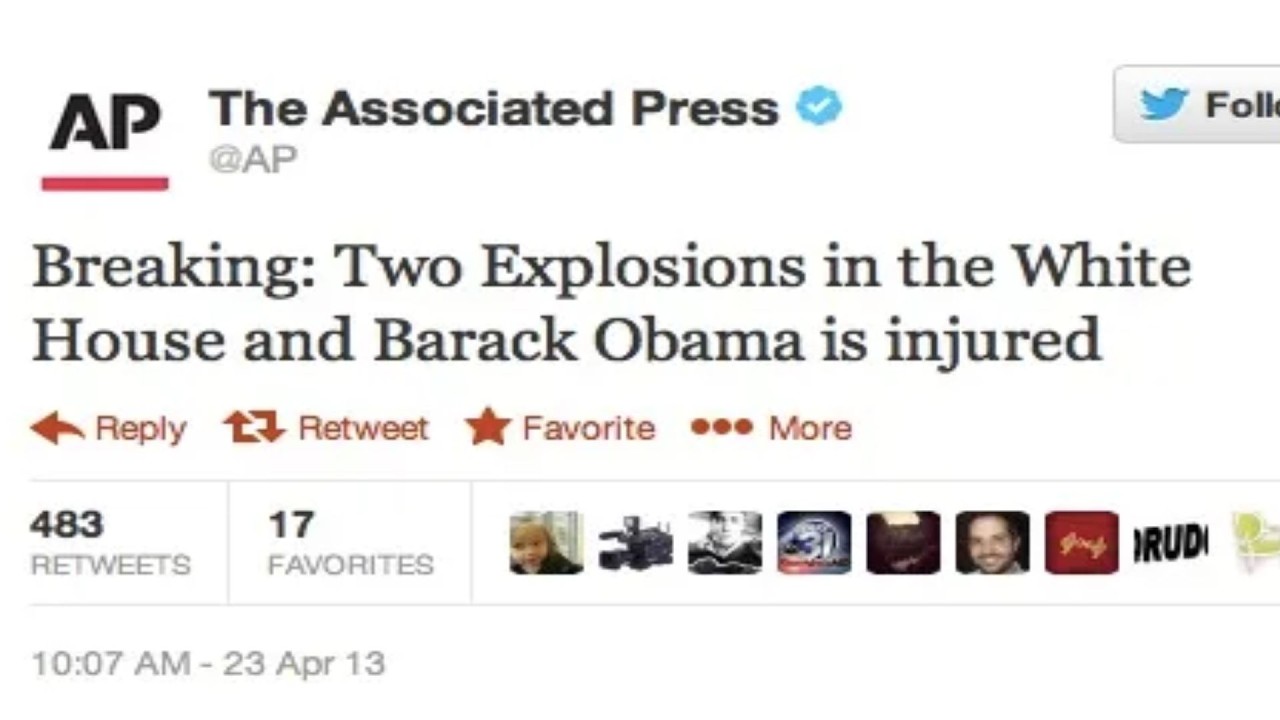
On 23 April 2013, the Associated Press's verified Twitter account sent a single sentence into the timeline: an explosion at the White House had injured President Barack Obama. The Dow Jones Industrial Average fell 150 points in seconds. The S&P 500 lost roughly $137 billion of market capitalisation before traders realised what had happened.
The tweet was fake. The AP's account had been hijacked by a Syrian hacker group that had stolen login credentials using a phishing email. From their own account, the attackers posted a taunt: "Oops, AP got owned, #by Obama." The whole event, from posting to retraction, took less than six minutes. Markets recovered almost as fast as they fell. But the lesson stuck — and markets have been relearning it in increasingly creative ways ever since.
A new retrospective from Australian investor and YouTuber Hamish Hodder walks through more than a decade of market-moving tweets. Some were hacks. Some were jokes. Some were clear attempts at price manipulation dressed up as news.

In July 2015, a Bloomberg-branded article claimed Twitter had received a $31 billion takeover offer. The stock jumped 8% in minutes. The catch: it wasn't published by Bloomberg at all. Someone had registered a lookalike domain and hosted a cloned article identical in layout to a real Bloomberg story. By the time the hoax was flagged, day traders with bots had already cycled through the spike.
The pattern repeats across the decade. Fake takeover letters for small-cap biotechs, doctored SEC filings shared through a single viral tweet, impersonated CEOs announcing dividends that did not exist, hacked newswire accounts pushing fraudulent earnings previews. In each case the movements were short-lived; in each case the timestamps show someone made money on the way up and the way down before the retractions landed.
Hodder's catalogue draws a direct line from those incidents to the current market regime, where macro-sized moves increasingly trace back to individual posts. Elon Musk's funding-secured tweet, resolved years later by an SEC-supervised settlement and a high-profile trial, is the canonical modern example. But the list is longer: a casual Cathie Wood retweet that sent options desks scrambling, a Donald Trump Truth Social post that added hundreds of millions in extended-hours volume to affiliated tickers, and a Jim Cramer tweet that has become its own contrarian trading signal.
What makes 2026 different is the infrastructure. Verification has weakened on major platforms following the 2023 Twitter paid-check rollout and subsequent imitators. Deepfake-grade voice and video are cheap. AI-written press releases are indistinguishable from the genuine article, and automated market-reading systems react to text on screen within milliseconds — well before a human compliance officer can intervene. The attack surface has widened while the defensive latency has shrunk.
The practical advice for retail investors has not really changed since 2013. Never take a single tweet as an execution trigger. Cross-reference against the underlying wire — Bloomberg, Reuters, Dow Jones — from a browser you control, not a forwarded link. Be especially wary of any headline that rewards an immediate long or short without giving the market time to absorb the news. If a trade looks like it has to be put on in the first thirty seconds, it is almost always a trade designed for someone else's account.
The deeper lesson Hodder draws is institutional. Markets are pricing in not just the news but the trust we extend to whoever carries the news. Each fake that slips through erodes that trust by a measurable increment — and each erosion makes the next manipulation cheaper to execute. Thirteen years after the AP hack, that compounding cost is still being paid in every fresh spike and retracement that fills a chart within a minute of a single post going live.