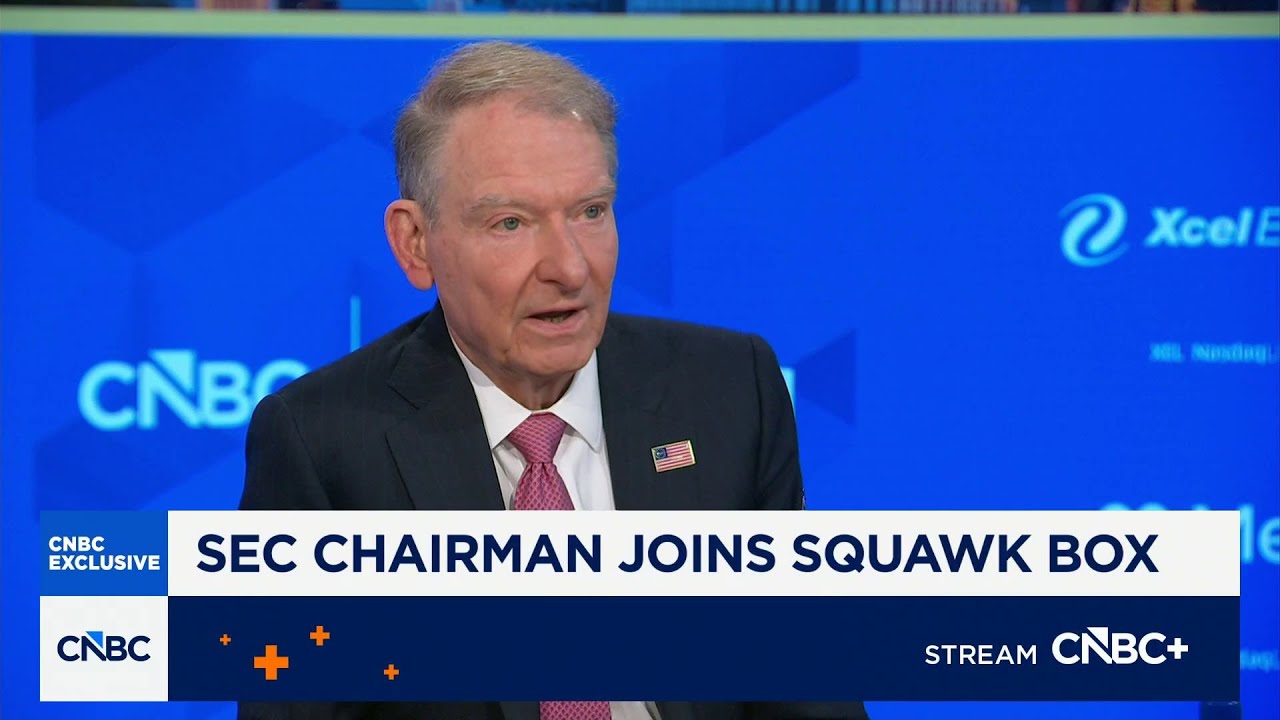
One year after taking the helm at the Securities and Exchange Commission, Chair Paul Atkins sat down with CNBC to describe a regulator that looks almost nothing like the one he inherited — and to defend a pivot that has infuriated Democrats and delighted Wall Street in almost equal measure.
Atkins framed his agenda as the 'ACT strategy' — Advance, Clarify, Transform — and said it was explicitly designed to end what he called the opaque, enforcement-first posture of his predecessors.
"We've pivoted from the old practice of regulation through enforcement and the opaqueness of the agency," Atkins told CNBC, singling out crypto policy as his first priority on arrival.

The 'advance' pillar, he said, is about modernising rules so innovative companies stop fleeing offshore. "Rather than fending off new innovative types of technologies, we're embracing them," he said. "And so to make them so that we'll bring them from offshore, where people fled, to come back to the United States to really work on their products."
On the 'clarify' pillar, Atkins pointed to the joint interpretive release the SEC issued with the Commodity Futures Trading Commission earlier in 2026, which for the first time drew explicit lines between tokenised securities and digital commodities. "SEC was very opaque as to how it would approach crypto and other things. We've clarified it with the CFTC. We had an interpretative release focusing on defining tokenised securities versus other digital assets that are commodities," he said.
The third pillar — 'transform' — is aimed at the shrinking US public company base. "We have half the number of public companies as we had 30 years ago," Atkins said. "And so where did that go? That went into the private markets. And so right now, what used to be a B round was a B round. Now it used to be an IPO."
Atkins argued three obstacles are keeping founders private: the cost and complexity of disclosure, 'vexatious litigation' risk, and what he described as the weaponisation of corporate governance by politicised shareholder activists. His remedy, he said, is a rulebook that is 'fit for purpose' — one designed to 'make IPOs great again' as a wave of mega-listings, led by SpaceX and potentially OpenAI and Anthropic, lines up for 2026.
Asked whether a market dominated by a handful of trillion-dollar listings could absorb the supply, Atkins was sanguine. "If you look at the things that are in offing now to go public this year, those are huge, huge companies. And for the most part, it's for liquidity because you have a lot of employees who now have shares and they want liquidity. They want a valuation that's true and set daily, hourly, by minute in the public markets."
The most politically sensitive moment came when Atkins was pressed on whether his agency was examining trading activity that appears to precede market-moving remarks from the White House. He declined to discuss specific investigations but did not dodge the premise.
"Things like that are disturbing," he said. "I can't talk to any particular investigation, but we are examining that area."
He added that insider trading and market manipulation remain central to the SEC's mandate. "Investor protection and focusing on market manipulation to stop market manipulation is very important to me, and obviously to the SEC, as part of our remit for investor protection and for having orderly, fair and efficient markets. So that is in our DNA."
Even on prediction markets — a rapidly growing category that has drawn bipartisan scrutiny — Atkins signalled the agency is not stepping back. Most of the activity, he noted, sits on the CFTC side under his former colleague Michael Selig, but he said the SEC is tracking the securities-law implications.
One year in, the shape of the Atkins SEC is unmistakable: less litigation, more rulemaking, a visibly softer hand on crypto, and a declared mission to reopen the US IPO pipeline. Whether the 'ACT strategy' can translate into durable policy — and survive the next change of administration — is a question that even its architect did not attempt to answer.