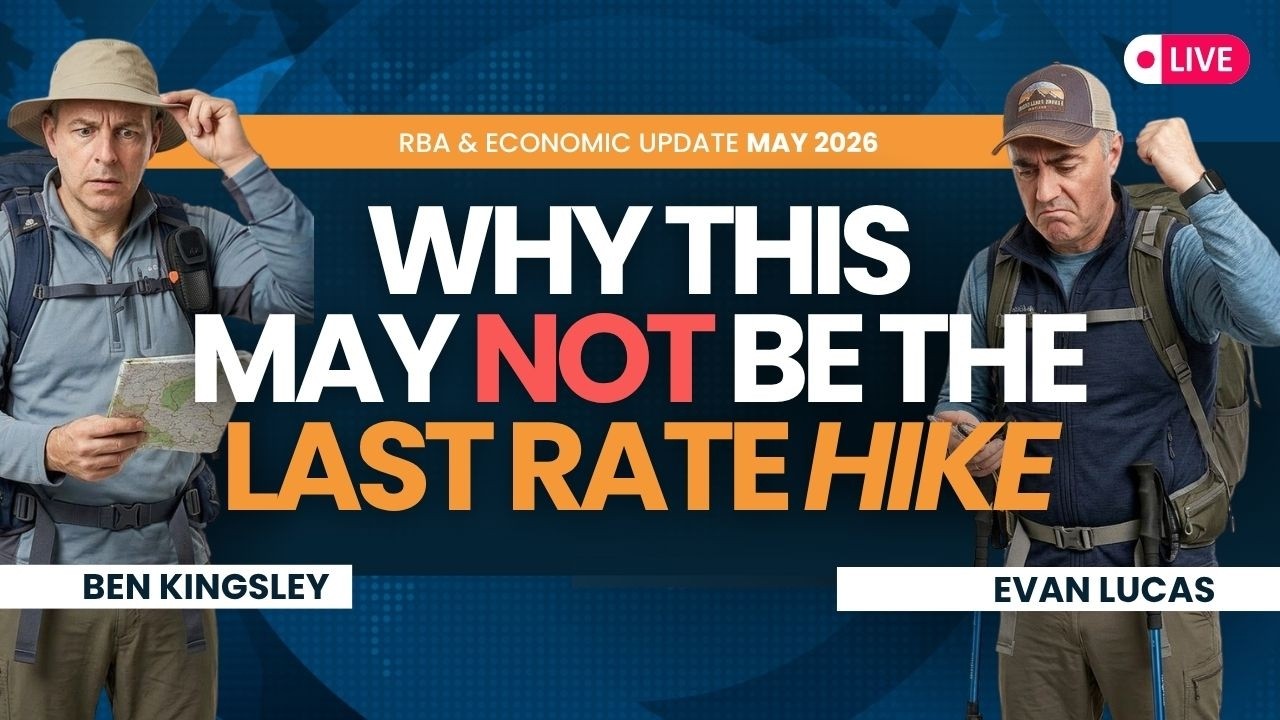
Property Couch host Ben Kingsley and economist Evan Lucas spent the bulk of their live May RBA broadcast dismantling the case that Tuesday's 25-basis-point hike to 4.35% was a one-and-done move, with both arguing the cash rate is more likely to peak near 4.85% by year-end.
The move took the official rate back to its 2024 peak and triggered the third hike of 2026. The accompanying RBA statement upgraded both inflation and underlying inflation forecasts and explicitly named 'plausible scenarios where inflation is higher, activity lower' than the new baseline, language Lucas read as the bank pre-positioning for being wrong on the upside.
'4.85 by the end of this year looks pretty likely,' Lucas said. 'It could be the highest since 2012.' He noted markets are now treating July as a probable pause but August as 'absolutely live', particularly if Brent crude pushes back through US$125 and bleeds into trim mean inflation through the second half. 'If oil prices keep going higher, I don't think they'll have a choice,' he said.
Lucas's reading of the RBA's own internal forecasts was that they remain optimistic. The bank now sees headline inflation peaking near 4.8% in June (revised from 4.2%) and 4% by year-end (from 3.6%), but Lucas argued an outcome closer to 4.85% headline by Christmas is the more honest baseline given Brent already trades between the RBA's 'baseline' (~US$100/bbl) and 'adverse' (~US$145/bbl) scenarios.
The trim mean track caught most of his attention. 'Trim mean now is going from 3.7 to 3.8 by June... and then it drops back to 2.5 in 2028, which is actually lower than the forecast. I think that's heroic,' he said. He pointed out that trim mean tends to take four to six months to absorb headline shocks, so the September and Christmas quarter readings could each carry a full three-handle as supply chain costs work through plastics, fertilizer, food and apparel.
Kingsley's framing for the broader macro was bluntly negative. 'Winter is coming for the Australian economy,' he said. 'The size of the economy's economic slowdown will depend on the Iran conflict and domestic inflation, interest rates increasing, consumer and business and government spending.'
The pair flagged the RBA's GDP downgrade as the under-reported number. The forecast for 2026 growth was cut to 1.3% from 1.8%, with the bank not seeing growth above 1.5% out to mid-2028. 'That is anemic growth,' Lucas said. 'That is with the margin of error suggests the RBA is worried about a recession.'
They argued the combination of falling growth, rising interest rates and an unemployment rate the RBA still pencils at just 4.3% by year-end fits the textbook definition of stagflation. 'Some of the economists are now predicting a negative Q1 and Q2 quarters which combined could be a technical recession,' Kingsley said.
The vote was not unanimous. Lucas highlighted the 8-1 split on the board, with one member preferring to hold. He suggested the dissenter likely argued that fuel-cost-driven headline inflation was already extracting enough cash from mortgaged and renting households to substitute for further policy tightening.
Key supporting data: Australian inflation hit 4.6% year-on-year in March (highest since September 2023), the NAB business confidence index plunged to negative 29 from zero (the second-largest monthly drop on record and the weakest since April 2020), and the Westpac-Melbourne Institute consumer sentiment index fell 12.5% in a single month - the largest fall since the COVID shock - with house-price expectations and job-loss fears both deteriorating sharply.
'I would bake in at least one more,' Lucas said of the rate path. 'I'm probably thinking more two than one.'