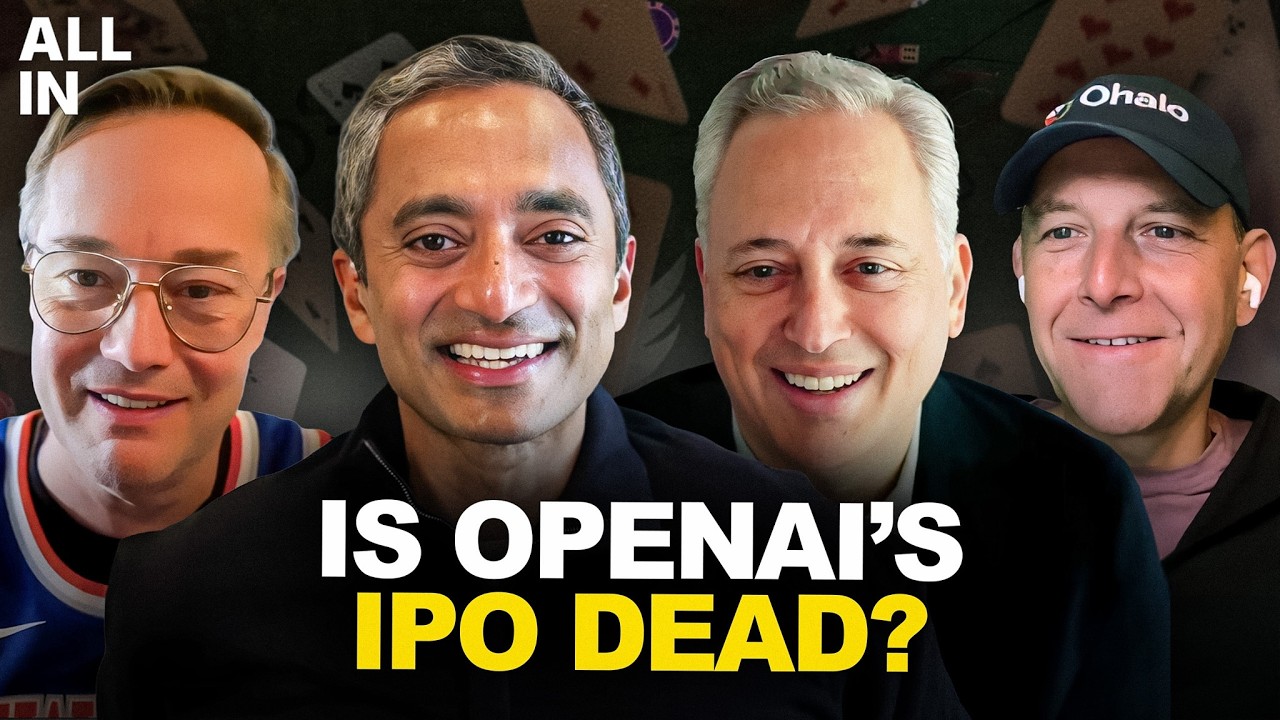
Elon Musk's $150 billion suit against OpenAI has opened in court with the kind of opening week that legal departments dread, after a Greg Brockman diary surfaced in discovery appearing to confirm the alleged plan to flip the original non-profit into a for-profit while pushing Musk out.
The lawsuit, which the All-In Podcast hosts called "the trial of the century or maybe the decade", accuses OpenAI of breach of charitable trust and unjust enrichment, demands that the company revert to a non-profit structure, and asks that chief executive Sam Altman and president Greg Brockman be removed.
Musk used his opening framing to widen the case beyond OpenAI itself.

"If we make it okay to loot a charity, the entire foundation of charitable giving in America will be destroyed. That's my concern," Musk said.
The most damaging exhibit so far is from Brockman himself. Excerpts read into the record from a personal diary describe the internal plan to convert OpenAI into a for-profit while telling Musk something different.
"Conclusion: we truly want the BC Corp. The true answer is that we want Elon out. If three months later we're doing BCorp, then it was a lie. Can't see us turning this into a for-profit without a nasty fight. I'm just thinking about the office and we're in the office and this story will correctly be that we weren't honest with him. In the end, it's still about wanting a for-profit just without him," the diary entries read.

"I just don't know why Greg Brockman has got a freaking diary where he's literally documenting. I mean, I love the guy, but what is he thinking? It's not just journal-maxing. It's discovery-maxing. It's smoking-gun-maxing. I don't get it," Friedberg said.
Chamath Palihapitiya delivered the more biting take, riffing on a scene from HBO drama The Wire.
"You taking notes on a criminal conspiracy? What are you thinking, man? If you're going to commit a crime, you do not write down the date and time of the crime in your journal," Palihapitiya said.
Despite the diary entries, the prediction-market view has barely shifted. Polymarket now puts the probability that Musk wins at roughly 42% to 43%, essentially flat through the discovery cycle, even as the social-media reaction has been dominated by the Brockman entries.
Jason Calacanis pointed at one possible explanation for the static market.
"One of the friends in our group chat said what may just happen is that Elon technically wins and he's just credited back the $40 million," Calacanis said, suggesting the market may be pricing a narrow legal victory rather than the broad structural unwind Musk is seeking.
The stakes for OpenAI are not limited to the $150 billion damages figure. A finding that the company breached its charitable trust could in theory force a reversal of the corporate restructure that converted the original non-profit into a capped-profit subsidiary and then into a fully for-profit benefit corporation. That structural unwind would directly affect the billions of dollars committed by Microsoft, Thrive Capital and the SoftBank-led round that lifted OpenAI's last private valuation past $500 billion, and would inject significant uncertainty into the multi-year compute and equity arrangements Anthropic, Google Cloud, Amazon and Microsoft have built around the AI labs.
The trial is running concurrently with a wider squeeze in the AI capital cycle. Anthropic and OpenAI have both reportedly missed Wall Street targets in recent quarters as power, not raw compute, becomes the binding constraint on data-centre rollouts. The hyperscaler $725 billion 2026 capex line printed across Google, Microsoft, Amazon and Meta has shifted the negotiating leverage back toward the cloud providers, with Anthropic in particular forced to give up structural economics to Amazon to secure capacity. A finding against OpenAI in the Musk case would land directly inside that environment, with knock-on effects for every counterparty that has built equity, credit or compute terms around the company's existing structure.