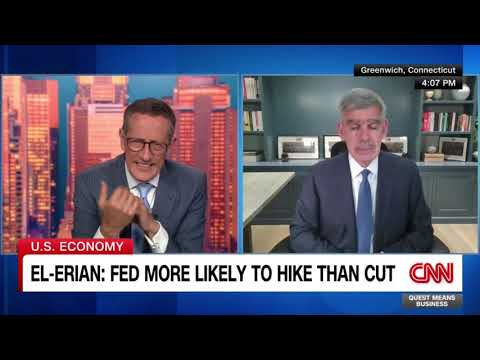
Mohamed El-Erian has told Bloomberg the US Federal Reserve will neither cut nor hike interest rates for "at least 18 months", arguing that incoming Chair Kevin Warsh is walking into a stagflation set-up where every option carries a punishment, and saying that if the Fed is forced to move at all, "it is more likely to be a hike than a cut".
The Allianz chief economic adviser and Wharton professor was speaking after a 3.8% US CPI print and the Senate confirming Warsh as a Fed governor — the procedural step that clears the way for his chairmanship vote. Markets have spent weeks debating whether Warsh would push for the rate cuts President Donald Trump publicly demands. El-Erian's answer was blunt: he will not, because he cannot.
"For now, meaning the next few months, they'll act by not acting. So they'll sit there, they'll wait and see how much of the high energy prices continues to percolate into the economy," El-Erian said. "Today's number was worse than expected. The consensus forecast was lower than what happened. And the Fed is going to look at this, and it's going to stop it from cutting rates for most of the year."

He framed the path from here as a four-stage economic shock from the Middle East war. "Number one is energy prices and interest rates go up. Number two, that we're seeing today, is it starts to be an inflation problem, much broader. Number three is the affordability issue becomes severe enough that people stop spending — that's demand destruction. And number four, hopefully we won't get there: you get financial instability."
That sequencing matters for fintech, banking and consumer-credit firms because El-Erian's central case is now a textbook stagflation outcome. "Playing it out over the next year, you have got classic stagflation," he said, contrasting the Fed's paralysis with central banks that have already moved. "Unlike the Bank of England, unlike the ECB, unlike the Reserve Bank of Australia that has started hiking, Norway has started hiking — they won't hike, but they also won't cut."
The US, in his view, is only partially insulated by domestic energy production. "The US is an exporter," he said, "but go to Africa, go to Asia — the Prime Minister has asked his citizens in India to consume less energy. What you're starting to see is real concern about physical shortages. And if that happens, it's a matter of six weeks for some parts of the world, then you get major contraction."
El-Erian then pivoted to the UK gilt market, where the 10-year yield has cracked 5% and the 30-year is at a 28-year high. He sounded an alarm that goes well beyond Westminster. "I cannot emphasize enough how worried I am," he said. "The 10-year is now at over 5%. That is crippling for mortgages and for businesses. It makes government debt more explosive. The 30-year is at the highest in 28 years."
The trigger for the gilt rout, in his reading, is not whether Keir Starmer or Rachel Reeves keeps their job, but whether the UK's commitment to fiscal discipline survives the political fight. "What the markets are wondering about is not whether the Prime Minister stays and goes, or whether the Chancellor stays or goes — it is, will their commitment to fiscal discipline remain?"
He invoked a recent memory that still haunts gilt desks. "You and I will remember 2022. We had what's called a Liz Truss moment, when suddenly the pension system was under enormous pressure. So I am really worried, and I'm hoping that we will see these rates come down, but they'll only come down if there's some reassurance that fiscal stability will be maintained."
For investors pricing US fintech and bank credit off the back end of the curve, El-Erian's combined call — no Fed cuts, a possible hike, sticky energy-driven inflation, a UK bond market on edge, and demand destruction next on the dance card — is one of the bleakest 18-month set-ups any senior strategist has put on the record this cycle.