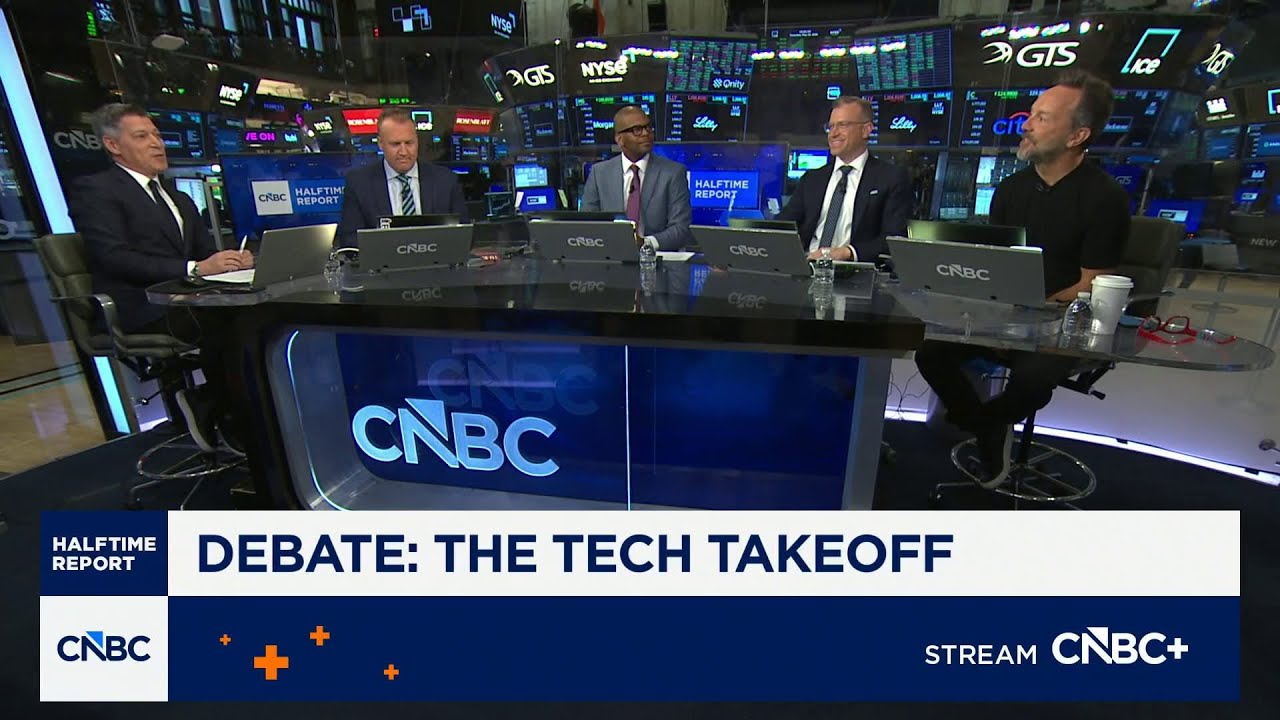
Altimeter Capital founder Brad Gerstner used the May 14 CNBC Halftime Report to argue that Nvidia, his firm's largest holding at almost 20 per cent of the portfolio, remains the cheapest trade in artificial intelligence even after a six-month range break to record highs. The interview ran the same morning that Altimeter portfolio company Cerebras Systems was awaiting its first public trade.
"The most unusual thing is Nvidia didn't do anything for six months as the rest of the semiconductor trade really catapulted to new highs," Gerstner said. "Remember, Nvidia hit US$210 a share at one time. On the March 30 low, I think it hit US$170 or US$172 a share. As our largest holding, it's almost 20 per cent of our overall portfolio, but it's actually been a drag from a performance perspective up until recently."
Gerstner brushed aside the Reuters report that the United States had cleared H200 chip sales to ten Chinese firms as the catalyst, calling China demand "de minimis at this point to Nvidia" given the US$1 trillion of orders the company has flagged for Blackwell and Vera Rubin chips over the next six to eight quarters. "This is a little bit of icing on top of the cake to be able to sell their older H200s to China," he said. "What's moving the stock is everybody's looking at the entire complex and saying — the most important company globally in AI, the best company executing today in AI is Nvidia. Why is it trading at 14 or 15 times fully tax GAAP earnings when the rest of the complex is so crazy?"

The Altimeter founder said the cap on Nvidia at US$180 reflected fears that custom silicon from Cerebras, Broadcom, Trainium and Google's TPU would erode Nvidia's roughly 80 per cent margins. He argued the market has now accepted that inference demand is large enough for multiple winners. "Notwithstanding Cerebras' success, notwithstanding Broadcom's success, notwithstanding the success of Trainium and TPU — Nvidia was still going to sell everything," Gerstner said. UBS has lifted its Nvidia price target to US$275 and Cantor to US$350 ahead of the company's May 20 earnings report.
On Cerebras specifically, Gerstner described the wafer-scale chip company as a nine-year bet on solving the memory wall. "We invested in Cerebras eight to nine years ago, and the idea was a long shot that they could do something nobody had ever done — put memory right on this wafer-scale chip right next to the compute. They pulled it off, and the world moved to them. Now it really matters. They have an unlimited amount of demand for their product."
The most striking framing came when Gerstner was asked what investors at home should take from the inference shift. "Here's the one thing to remember. There is no intelligence. There's no consumer ChatGPT. There's no enterprise intelligence. There's no Cloud Code without the production of tokens," he said. "It's the production and consumption of tokens that is intelligence."
He pointed to a two-year-old podcast clip with Nvidia chief executive Jensen Huang in which Huang said inference compute would scale by "a billion times" through chain-of-reasoning models. "Jensen told us, like, we knew inference time reasoning was going to change the game," Gerstner said. "He told you it was going to one billion x. The reality is not many people listened."

The Altimeter chief flagged power and data-centre supply as the binding constraint for both Nvidia and Cerebras going forward. He also noted that five S&P 500 companies cited soaring compute and token costs on their earnings calls this season as a material drag on profitability — the underlying demand signal that has reset Nvidia's multiple. "The economic law of gravity here is that if they deliver the returns we expect, one of two things is going to happen. Either they'll buy back all their own shares because the market won't value them, or the market will buy them."