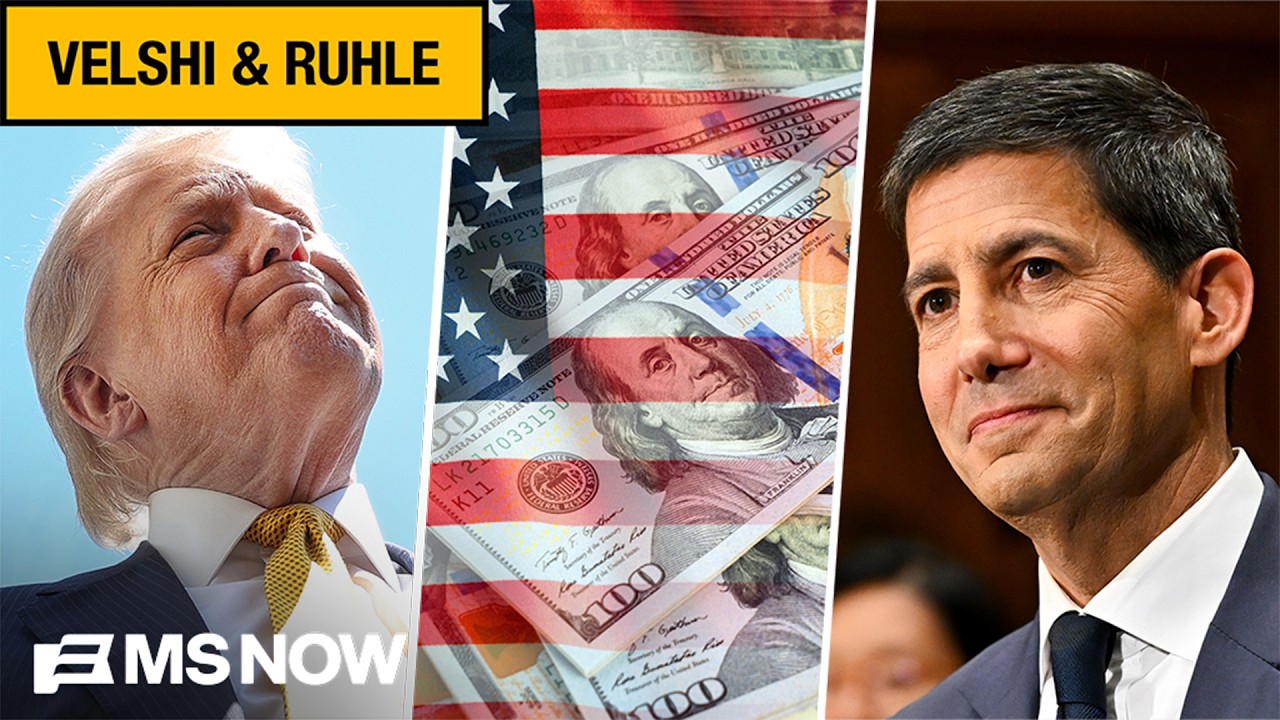
University of Michigan economist Justin Wolfers used his May 14 appearance on MS NOW with Ali Velshi to flag what he called a fundamental identity question hanging over the Federal Reserve under newly-confirmed chair Kevin Walsh. The Senate confirmed Walsh on a party-line vote earlier in the day.
"They haven't announced the most important thing, which is which Kevin Walsh," Wolfers said. "There's a fellow by the name of Kevin Walsh, who is devastatingly handsome, who was a member of the Federal Reserve Board between 2006 and 2011. That Kevin Walsh, through that entire period where inflation was too low, the recovery was too slow, the US was more at risk of deflation after the financial crisis than anything else — that Kevin Walsh, everywhere he'd look, he'd see inflation and be scared and worried even though it wasn't anywhere to be seen. That Kevin Walsh was what economists call an inflation hawk. Some people even call these folks inflation nutters."
That history sits awkwardly with President Trump's stated reason for selecting Walsh. "He has the same birth certificate as the bloke who turned up at the Senate confirmation, who was appointed by a president who said he wants someone who believes in low interest rates — who will cut interest rates to one per cent even though we're currently at a moment of nearly four per cent inflation," Wolfers said. The economist also noted Walsh declined to answer Senator Elizabeth Warren's question about who won the 2020 presidential election during his confirmation hearing — "a simple question to test whether he would maintain the independence of the Fed."

The inflation backdrop is the most hostile a new Fed chair has inherited in a decade. April producer prices rose 1.4 per cent month-on-month — the largest monthly jump in four years — and US gasoline prices are up roughly 50 per cent since the start of the Iran war in March, having begun the conflict 20 per cent higher year-on-year. Fuel oil was up 44 per cent year-on-year as of March. "It doesn't matter whether you drive," Wolfers said. "Farms use diesel. Everybody who transports everything uses diesel. Airplanes use fuel. Food preparation uses energy. There's nobody who's not affected by higher energy prices."
Wolfers pushed back on the easy 1970s stagflation parallel, arguing the US economy is structurally less exposed to oil today and that the Strait of Hormuz disruption is propagating through producer prices rather than direct shortages. "The amount of oil per pound of GDP has gone down a lot. We're much less dependent. And the US now is roughly energy independent — we basically make as much oil as we use. But that doesn't fully insulate us, as we're all learning right now." The producer-price index, he explained, captures the bread-and-butter costs that small businesses face well before the consumer-price index registers them. "Anything that raises producer prices in an enduring way will end up raising sandwich prices."
The most provocative segment was an event-study analysis Wolfers ran on the question of why stocks keep printing record highs against this backdrop. "It turns out, if you do that over the past few weeks, every single time the president has leaned into his belligerence, the US stock market has fallen," he said. "Every time it looks like he might back-track, every time it looks like the peace doves are out, stocks rise. What you learn from that is traders are trading as if they believe the value of stocks is higher if we don't go to war than if we do. By the way, we saw the same thing during the trade war."
Wolfers framed the entire situation as a stress test of Fed independence — a structural feature he argued separates the United States dollar from the currencies of Turkey, Zimbabwe, Venezuela and Argentina. "Those that maintain independence from their political system tend to come to similar conclusions and do similar things. They're, and they should be, quite boring. If economics starts to sound like soap opera, you're doing it wrong." He cited John Maynard Keynes's wish that economists be "as boring as dentists" — a benchmark Wolfers said the Walsh-era Fed will be hard-pressed to meet.