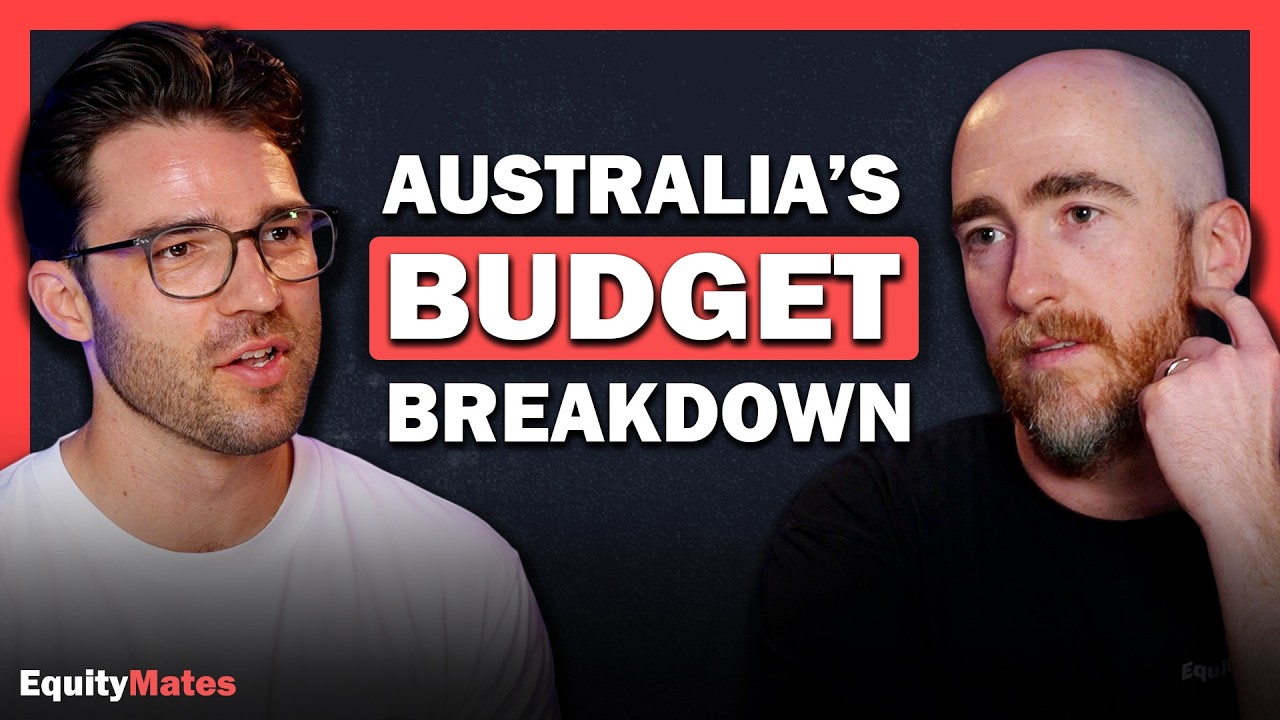
Equity Mates co-hosts Bryce Leske and Alec Renehan have argued the federal budget's overhaul of capital-gains tax has dragged Australia from a middle-of-the-pack jurisdiction for entrepreneurs into one of the worst places in the developed world to build a company. The May 14 episode, recorded in the wake of the budget being handed down on Leske's 35th birthday, focused on the unintended consequences of the new 30 per cent minimum capital-gains tax floor.
The budget replaced the existing 50 per cent capital-gains tax discount with a cost-based indexation regime tied to inflation, paired with a minimum 30 per cent rate on every dollar of gain. Negative gearing has been limited to new builds for any property settling after 7:30pm on budget night, with existing arrangements grandfathered. Trust distributions now attract a minimum 30 per cent tax rate. The changes take effect from 1 July 2027.
Leske and Renehan said the structural problem is the elimination of the tax-free threshold on capital gains. "In instances where your partner might be on maternity leave and you sort of sell down some stock to help fund that, or you have a distribution through a trust, we've all relied on this tax-free threshold when it comes to capital gains. Now, every single dollar of capital gains is a minimum 30 per cent," Renehan said. "The real stitch-up."

The knock-on effect on the Australian financial-independence-retire-early cohort was flagged as severe. "If you're doing FIRE and you're thinking, I'm going to work and save and build my assets to a point where I can quit my job and then I'm going to slowly sell down those assets — well, now you can't rely on that tax-free threshold anymore because you're selling assets rather than earning income," Renehan said.
The sharpest critique was reserved for the founder economics. Renehan cited an analysis by Wilson Asset Management chair Geoff Wilson and venture investor Chris Joye, published in the Australian Financial Review and circulated on Twitter, comparing tax outcomes for a hypothetical founder who built a business with A$250,000 in capital and sold it for A$5 million ten years later. "Australia now becomes the worst place to start a business," Renehan said. "Which is not exactly what we're aiming for when people and capital is so mobile, and there's a huge brain drain of Australians already going to the US."
Leske argued the budget conflated property reform with broader investment policy. "They wanted to deal with the spiralling cost of property, which is something that needs to be dealt with. But the way to do that would have been to make tax on property more onerous than tax on other asset classes to create the incentive to push people away from property. Instead, we got changes across everything. And the one that's probably going to hurt the most is this 30 per cent minimum capital gains."
Treasurer Jim Chalmers has acknowledged the blowback by promising further consultation with the startup sector. "Charas — in the classic case of dealing with the problem after it's been created — has now said they're going to go consult with industry early stage because of the blowback," Renehan said. "It's like, wasn't the time to do that before the budget?"
The pair did concede the grandfathering of existing negative-gearing arrangements was the right call. "Grandfathering negative gearing was the right thing to do, because it hopefully will minimise the incentive for existing landlords to raise rents to positively gear their property," Leske said, drawing the parallel to the brief 1985 Hawke-government removal that was reversed in part because of rental impact.
Not all the headline measures landed badly. The pair flagged the A$250 working Australians tax offset for 2026-27 as "roughly $5 a week" and the A$25 billion in extra public-hospital funding over five years as a clear win. The biggest savings line was the National Disability Insurance Scheme tightening, with an estimated 160,000 participants set to be removed and savings projected at between A$15 billion and A$37.8 billion over four years depending on the source. "What we didn't see, and what I was hoping they would really come out of left field and do, is actually give us a gas tax," Leske said, citing the Parliamentary Budget Office's estimate that such a measure would have raised roughly A$17 billion a year — almost double the NDIS saving on the lower estimate.