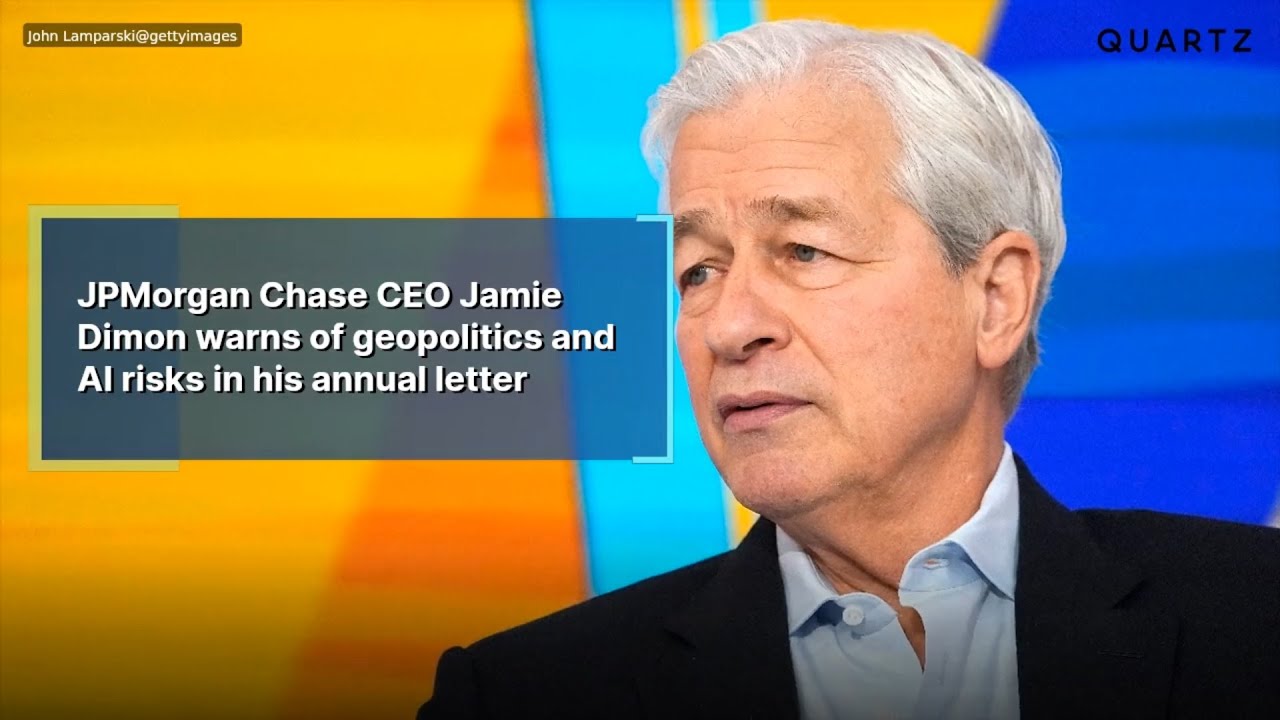
JPMorgan Chase kicked off the US bank earnings season with a quarter that, on the numbers, looked almost too easy. Net income of $16.5 billion, revenue of $50.5 billion — up 10% year on year — diluted earnings of $5.94 against a $5.44 consensus, and a return on tangible common equity of 23%. The market reaction was muted. The reason was Jamie Dimon.
The long-serving chief executive used the earnings call, and a lengthy annual shareholder letter published the same week, to argue that the real story of 2026 is not the headline numbers but a risk environment he described as 'increasingly complex.' The letter placed the conflicts in Ukraine and Iran, instability across the Middle East and accelerating tensions with China at the top of the threat list, writing that 'the outcome of current geopolitical events may very well be the defining factor in how the future global economic order unfolds.'
Dimon was especially pointed on private credit. JPMorgan has consistently flagged the $1.8 trillion asset class as a source of growing concern, and he repeated the warning on the call while stopping short of calling it systemic.

"I don't think it's systemic," Dimon told analysts. "It almost can't be systemic at that size relative to anything else."
His caveat was that credit quality and underwriting standards have visibly slipped, echoing Jerome Powell's own recent remarks about opaque valuations. Chief financial officer Jeremy Barnum disclosed the size of JPMorgan's own exposure. "About $60 billion for us," Barnum said, "characterised by underwriting, diversification, cash flow trapping."
On the traditional consumer credit book, the message was calmer. "All looks consistent with prior trends and fundamentally healthy," Barnum said. "The biggest reason credit performance is healthy is labour market strength." The bank's consumer and community banking division continued to lead revenue growth, supported by resilient card spend and a flat but elevated net interest margin.
Cyber risk got the starkest phrasing of the quarter. Asked to rank the threats he spends the most time on, Dimon did not hedge. "It's our largest risk," he said. "JPMorgan is very well protected. We spend a lot of money." That framing is consistent with the bank's accelerating cybersecurity capital expenditure through 2025 and 2026 and reflects a view, widely held across the Big Four US banks, that state-linked attackers now rival market shocks as the most consequential operational threat.
Artificial intelligence drew a more philosophical answer. Dimon rejected the framing that AI investment is hype and reiterated that JPMorgan will deploy it broadly for customers and employees. He was clear about the competitive logic. "In a competitive world, I'm going to do it, everyone else is going to do it, and the benefits will be passed to the marketplace," he said, while acknowledging AI could displace workers and urging stronger retraining and support systems.
The annual letter and call also laid out his position on the current regulatory cycle. Dimon told investors the bank's Common Equity Tier 1 capital would rise around 4% under the proposed Basel 3 Endgame and GSIB surcharge revisions, even as the Federal Reserve's own estimate for the large-bank sector is closer to a 5% reduction. "Our CT1 capital would increase around 4% under proposed rules, while the Fed's estimate for large banks is about a 5% reduction," Barnum told analysts — an unusually direct gap to call out on a public call. Dimon characterised the post-2008 regulatory stack as 'a fragmented, slow regulatory system with overlapping rules that weaken finance and reduce productive lending.'
On capital return, he was equally candid. "Our preferred way of using capital is not buying back stock today," Dimon said. "I'd rather buy back stock when it's a real discount." JPMorgan's repurchase pace in the quarter was accordingly subdued, with the bank preferring to hold capital against the risk backdrop its chief executive had just described.
The final note was strategic. Dimon confirmed that JPMorgan is exploring a controlled push into prediction markets through Kalshi and Polymarket, excluding sports and politics. It is a small signal but a telling one: even the most regulated lender in the United States is willing to take a measured step into the fastest-growing new asset class of the cycle, if only because the trading economics and information value are becoming impossible to ignore.