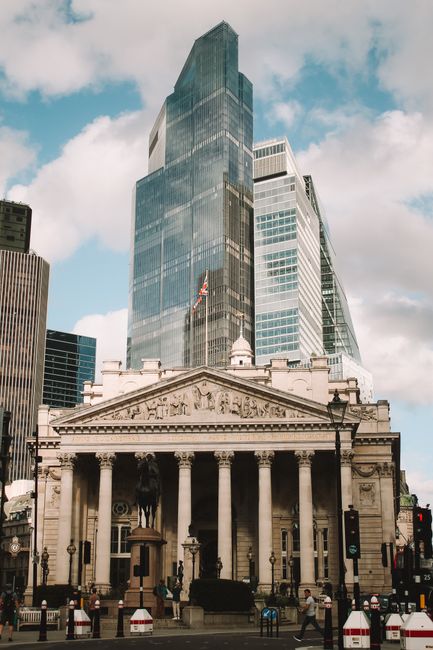
The most senior Bank of England official with explicit responsibility for financial stability has used a BBC interview to deliver one of the bluntest market warnings any G7 central banker has issued this cycle, arguing that global stock prices are detached from the risks below them and that the next crisis is more likely to come from outside the regulated banking system than from inside it.
"There's a lot of risk out there and yet asset prices are at all-time highs. We expect there will be an adjustment at some point," Deputy Governor Sarah Breeden told the broadcaster. The comment lands with the S&P 500 still within touching distance of its all-time high, the Nasdaq fresh off a thirteen-day winning streak, and Ethereum-treasury and AI-leveraged equities trading at multiples that strategists from JP Morgan to Bernstein have flagged as historically rich.
Breeden was unusually specific about which combination of risks is keeping her up at night. "The thing that really keeps me awake at night is the likelihood of a number of risks crystallising at the same time – a major macroeconomic shock, confidence in private credit goes, AI and other risky valuations readjust – what happens in that environment and are we prepared for it?" she said. The triple-shock framing is significant because it abandons the single-channel risk models that defined post-2008 stress testing and acknowledges that an AI repricing, a private-credit run and a macroeconomic shock are now correlated rather than independent.

The deputy governor's most pointed warnings were about private credit, the asset class that has ballooned from a niche LP product to a $2.5 trillion industry while sitting almost entirely outside the perimeter of bank regulation. "Private credit has gone from nothing to two and a half trillion dollars in the last 15 to 20 years. It hasn't been tested at this scale with the degree of complexity and interconnections it has with the rest of the financial system so far. It's a private credit crunch, rather than a banking-driven credit crunch, that we're worried about," she said.
Breeden's intervention dovetails with a separate set of remarks from Bank of England Governor Andrew Bailey, who told a recent regulatory audience there is "a particular and urgent need" for stronger global safeguards over a sector he described as "very large and fast-growing" but "opaque in key areas". Bailey added that "the challenge now lies in managing risks that sit beyond the banking perimeter as well as identifying and understanding new interconnections between banks and non-banks," the latter a euphemism for private credit funds, hedge funds and insurance-linked vehicles. The BoE has launched a system-wide stress test specifically targeting how shocks would propagate through the non-bank sector, the first such exercise of its kind in Europe.
The Bank's framing matches what US Treasury Secretary Scott Bessent has been saying on the other side of the Atlantic. Bessent told CNBC's Investing in America Forum, "We are concerned," when asked about the explosive growth of Blue Owl and other private lenders, and added: "If there is something rotten, it is not going to be handed to the individual investors." His position so far is that private credit "has been very additive" but that Treasury wants to know "how does it affect the regulated system, and we want to prevent contagion."
For markets, Breeden was careful not to call a top. "What we are watching for is: how might those prices fall? Will there be a sharp adjustment downwards? And if there is such an adjustment, how will that affect the economy? I'm not saying it will happen today, tomorrow, in 12 months' time. It's ensuring that if it happens the system is resilient," she told the BBC. The position aligns the BoE squarely with the Bank for International Settlements, which warned earlier this month that dollar stablecoins look "more like ETFs than money" and that emerging markets sit in the blast radius of a sudden private-credit repricing.
What makes the Breeden interview different from a normal central-bank-warning news cycle is that the messenger is the deputy governor for financial stability rather than for monetary policy. That means the BoE is no longer treating this as an inflation or rate-path discussion, but as a question of whether the post-pandemic plumbing can absorb a simultaneous shock. The fact that Breeden chose to deliver the warning to the BBC rather than to a closed City of London audience suggests the Bank has decided that public communication is itself part of the resilience strategy.