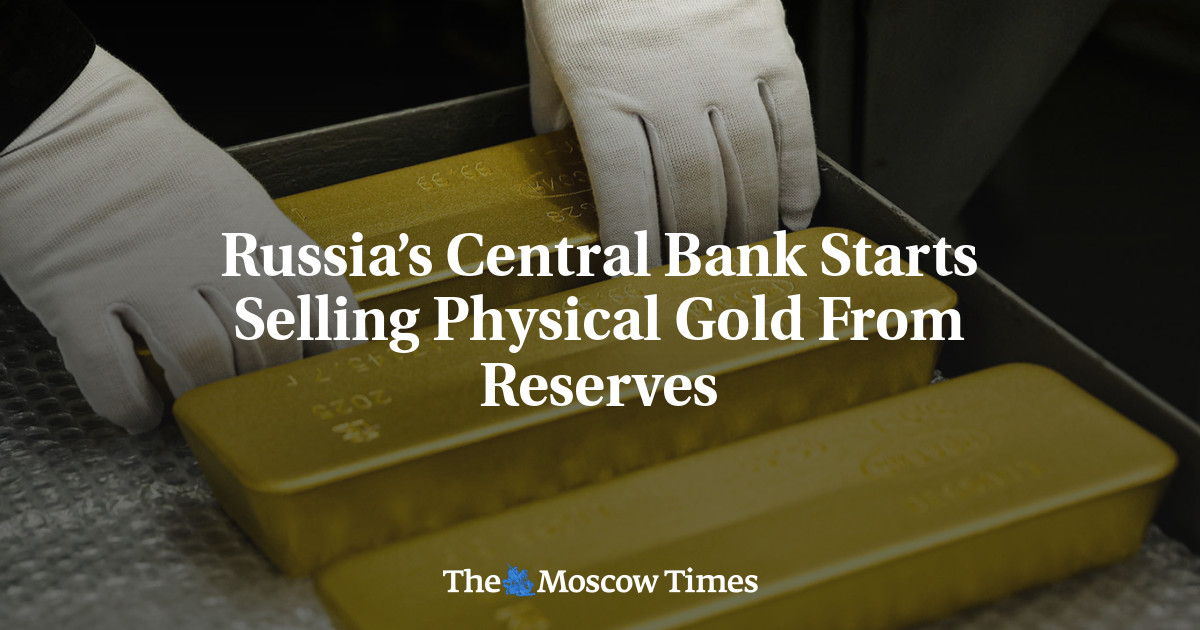
In a notable development, Russia's Central Bank has started to sell physical gold from its reserves for the first time, as part of efforts by the Finance Ministry to fund the state budget. The announcement, made on Wednesday, marks a shift in how the Bank has previously handled its gold resources. Until this point, transactions involving gold from the National Wealth Fund (NWF) were primarily virtual, with the government selling gold to the Central Bank while retaining the bullion within the country’s reserves.
The significance of this move is underscored by the fact that Russia holds more than 2,300 tons of gold, representing the fifth-largest reserves globally. “With domestic gold market liquidity having increased in recent years, the Bank of Russia now conducts equivalent operations on the domestic market not only through yuan transactions but also partially through gold,” said a spokesperson from the Central Bank.
While the specific details regarding the timing and volume of the gold sales have not been disclosed, the implications of this strategy are profound. Prior to the onset of the full-scale invasion of Ukraine, the NWF contained approximately 405.7 tons of gold. As the conflict intensified, the Finance Ministry has seen fit to liquidate a significant portion—57% or 232.6 tons—to address budgetary shortfalls, leaving the NWF with 173.1 tons as of November 1.


As the NWF's overall liquid assets, encompassing gold and yuan, dipped by 55% to $51.6 billion, the economic pressures on the Russian economy have become more pronounced. Analysts are recognizing the broader context of these gold sales. “Using gold spreads pressure across markets and maintains reserve diversification,” noted Vladimir Chernov, an analyst at Freedom Finance Global. This strategy, he explained, enables the Central Bank to inject currency into the marketplace, thereby providing support to the ruble and relieving some strain on yuan holdings.
Impact and Legacy

Impact and Legacy
Impact and Legacy
This strategic pivot towards gold sales reflects a growing trend within the Russian financial system, aimed at stabilizing the economy amid mounting pressures. The Central Bank's decision is not without its critics, who express concern about the long-term impacts of such measures on national reserves and economic health.


As Russia navigates through a challenging economic terrain largely shaped by geopolitical conflicts, the evolution of its financial strategies will be increasingly scrutinized. Observers are keenly watching how these sales will affect the broader financial landscape in Russia and whether it will lead to a more robust support system for the undervalued ruble or introduce further volatility into the market.
Looking Ahead
Looking Ahead
In summary, the Central Bank's foray into selling gold signals a new phase in Russia's economic strategy as it grapples with the ramifications of ongoing sanctions, a fluctuating ruble, and the need for greater financial liquidity. The outcomes of these sales will likely shape the future of the country's economic policies and its standing in the global gold market. As Russia continues to make these financial adjustments, the economic landscape will undoubtedly remain dynamic and closely watched by experts and stakeholders alike.