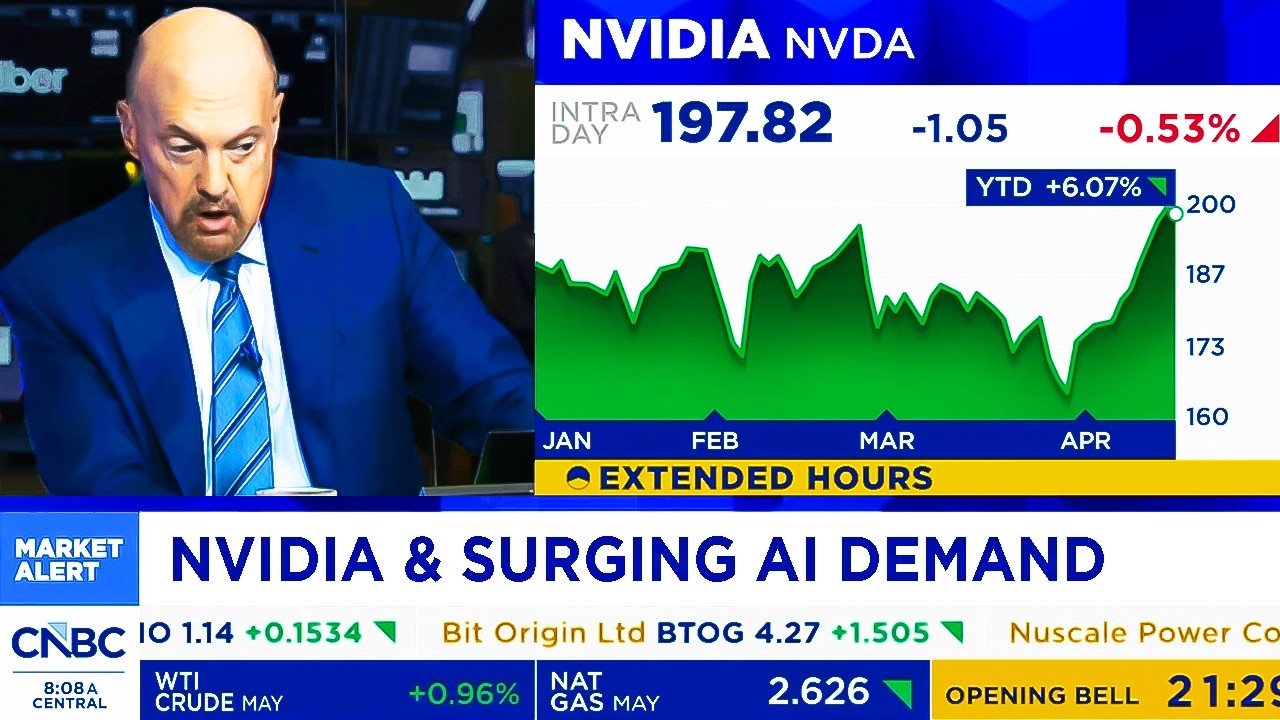
Nvidia chief executive Jensen Huang turned a podcast interview with Dwarkesh Patel into an open challenge aimed directly at the custom AI chip programs at Amazon and Alphabet, telling the two hyperscalers to post their numbers on public inference benchmarks or stop claiming a total cost of ownership advantage.
"Nobody can demonstrate to me that any single platform in the world today has better performance TCO ratio. Not one company," Huang said. "And in fact, in fact, the the uh the benchmarks are out there. uh Dylan's right inference max is sitting out there for everybody to to use and not one TPU won't come train won't come I I encourage them to use inference max and demonstrate their incredible inference cost it's really really hard uh not nobody wants to show up uh ML perf I would I would welcome Trainium to demonstrate their 40% that they claim all the time I I would love to to hear them demonstrate the the uh cost advantage of TPUs. It makes no sense in my mind. It makes absolutely zero sense on first principles."
The comments, which aired on the Dwarkesh Podcast and were replayed by CNBC anchor David Faber alongside Jim Cramer on Squawk on the Street, were read as an unusual direct shot by Huang at the two largest external buyers of Nvidia's data center chips.
Cramer, who has covered Huang for years, described the segment as an "evisceration" that carried weight precisely because it was delivered analytically rather than emotionally. "What he is? He's a serious person," Cramer said. "Why do I love Jensen? That was an evisceration. Do you think it was done in the way that I like eviscerate? I'm screaming at people. No, it had rigor."
Nvidia's supporting argument went further in a blog post titled "Rethinking AI Total Cost of Ownership." Nvidia's position is that flops per dollar, the traditional benchmark for AI hardware value, is the wrong measure once the data centre's primary job is generating tokens rather than storing bits. The right measure, Nvidia argues, is cost per delivered token, which incorporates software, utilisation and ecosystem effects. On that metric, Huang has now said publicly that Nvidia wins and that no competitor has matched its claim on an auditable benchmark.
Huang also went after the strategic logic of the hyperscalers' custom-silicon partnerships. He argued Anthropic is singular rather than a template for a broader shift. "Without anthropic, why would there be any TPU growth at all? It's 100% anthropic. Without anthropic, why would there be any tranium growth at all? It's 100% anthropic."
Huang said Google and Amazon secured Anthropic's chip commitment by investing heavily in the AI lab when it could not raise the money elsewhere, and that Nvidia, not yet in the business of investing in customers, simply was not able to compete for that deal. "It was a mistake for Nvidia to allow Google and Amazon to invest in Anthropic early on in return for Anthropic using their custom AS6," he said, adding that he would not make the same mistake again.
The demand backdrop Huang described is the clearest Nvidia has given on inference in months. Hourly rental prices for Nvidia's Blackwell B200 and B300 GPUs are now around $412 per hour, up about 40% in two months, according to data from startup Orin AI, whose founder Kush Pavaria told CNBC his team has built a Compute Price Index and plans futures contracts to financialise compute. "Demand for compute today is insatiable. Every single person wants to use an AI model."
Dell Technologies CEO Michael Dell backed the Nvidia view at the Invest in America conference. Describing Dell's own customer base, he said enterprises are still at the very start of the AI adoption curve. "They're all just on the early adoption phase of what I would refer to more as the tools. They haven't even gotten to the agents and the recursive self-improvement which drives just a massive increase in the amount of tokens."
Anthropic's annualised revenue run rate has climbed past $30 billion from $9 billion at the end of 2025. TSMC's first quarter revenue rose 35.1% year-on-year and the company lifted 2026 capex guidance toward the top of its $52 to $56 billion range. Gil Luria of DA Davidson told CNBC the combined signal points the other way from the market's caution, saying Nvidia and TSMC are both growing faster than 35% and "trading in the low 20s on earnings."
Nvidia reports earnings on 20 May.